China and
Okinawa 2011

Boo, find font

  • RSS
  • Delicious
  • Digg
  • Facebook
  • Twitter
  • Linkedin

About the Trip

In April 2008 I took my first trip to China and fell in love with the country. Never had I felt so out of my element, so off balance and yet still in awe of an ancient culture as I did when I was being stared at walking along the Great Wall of China. After spending 28 days traveling from Beijing to Chengdu I vowed I would come back to this fascinating country and see the southern half and Tibet. I planned a great many trips, but at the last minute they always fell through.

Three years later the chance to go back to China has finally come. This time instead of going with my husband and our good friend Justin, I will be traveling with my sister Melody and her husband Dave. While I wont be seeing Tibet yet again, I will be exploring more of the southern half of China.

The adventure begins in Beijing and progresses onto Chundu, Leshan to see Mt.Emei, Jiuzhaigou, Lijian and finally back to Beijing. I will get to walk on the Great Wall of China again, see the largest stone Buddha in the world and trek through Tiger Leaping Gorge. It should be a fantastic trip, filled with new experiences and the chance to see a more wild side of China than I have ever experienced before.

Thumbnail Recent Post

Recent Comments

  • Sit amet felis. Mauris semper, velit semper laoreet dictum

    The adventure, the trials and the triumphs of my 2011 trip to China with my sister Melody and her Husband Dave.

  • Category name clash

    Lorem ipsum dolor sit amet, consectetuer adipiscing elit. Quisque sed felis. Aliquam sit amet felis. Mauris semper, velit semper laoreet dictum, quam diam dictum urna, nec placerat elit nisl in ...

  • Test with enclosures

    Here's an mp3 file that was uploaded as an attachment: Juan Manuel Fangio by Yue And here's a link to an external mp3 file: Acclimate by General Fuzz Both are CC licensed. Lorem ...

  • Block quotes

    Some block quote tests: Here's a one line quote. This part isn't quoted. Here's a much longer quote: Lorem ipsum dolor sit amet, consectetuer adipiscing elit. In dapibus. In pretium pede. Donec ...

Posted by Crystal - - 0 comments

The Adventure Begins, Arriving in Beiging

Day 1 in China: Arrive in Beijing
Transfer via: International flight UO304 (-23:30) arranged by you. Upon your arrival at the Beijing airport, your local guide and private vehicle will meet you and escort you to your hotel. The rest of the day is yours to relax and recover from jetlag.

The day started off with last minute packing, rearranging and cleaning the house but an over all lazy morning. Crystal Crawford stopped by to pick us up early in the afternoon and after a quick jaunt to the airport and a mostly painless boarding onto our plane in the tiny international section of the Naha airport we were on our way to Hong Kong.

Depart: Naha Field (OKA) Okinawa 16:20
Arrive: Hong Kong Intl (HKG), Terminal 1 18:05


The flight was short an uneventful. Hong Kong Express Airways turned out to be pretty decent over all. Leg room enough for even Dave and a fair in flight meal, even on this short international flight. Stewardesses also seemed pleasant enough, unlike every US flight I have ever had, it seems China still believes at least a little that flight attendants have a customer service job. After a short wait in the Hong Kong airport, we were off again to Beijing.

Depart: Hong Kong Intl (HKG) , Terminal 2 20:15
Arrive: Beijing Capital Arpt (PEK), Terminal 2 23:30


The Beijing airport is of course a breeze to get through and after a short few minutes we were headed outside to meet our first guide "Summer".


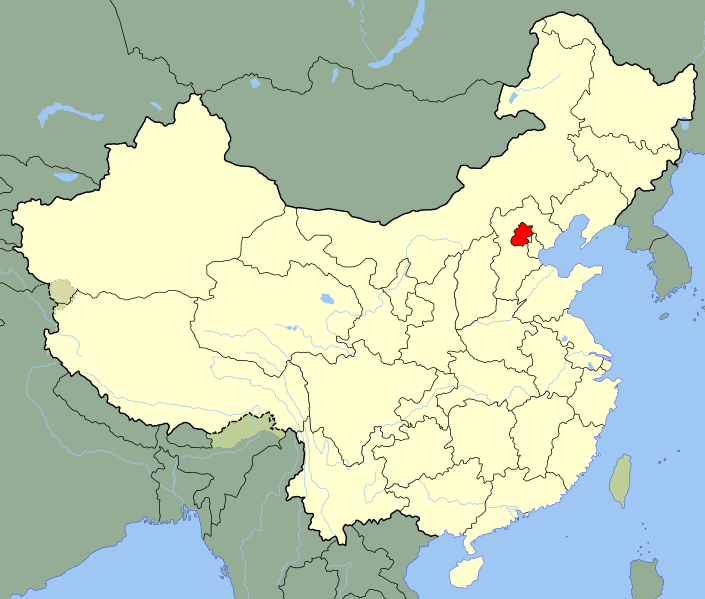
Beijing (pronounced /beɪˈdʒɪŋ/, Chinese: 北京; pinyin: Běijīng), also known as Peking (pronounced /piːˈkɪŋ/ or /peɪˈkɪŋ/), is a metropolis in Northern China, and the capital of the People's Republic of China. Governed as a municipality under direct administration of the central government, Beijing borders Hebei Province to the north, west, south, and for a small section in the east, and Tianjin Municipality to the southeast. Beijing is one of the Four Great Ancient Capitals of China.

Beijing is recognized as the political, educational, and cultural center of the People's Republic of China, while Hong Kong and Shanghai predominate in economic fields. The city hosted the 2008 Olympic Games. Few cities in the world besides Beijing have served as the political and cultural centre of an area as immense as China for so long. The Encyclopædia Britannica describes it as "one of the world's great cities," and declares that the city has been an integral part of China’s history for centuries; there is scarcely a major building of any age in Beijing that does not have at least some national historical significance. Beijing is renowned for its opulent palaces, temples, and huge stone walls and gates. Its art treasures and universities have long made the city a centre of culture and art in China.

Our guide Summer introduced us to Beijing as we drove the roughly 40 minutes to our hotel in the middle of the city. Unfortunately it was almost 1:00 am and none of us was in any particular mood for conversation. The city lay shrouded in darkness, only the neon lights illuminated the night. I was excited to see the changes in Beijing since my last visit in 2008 but it was going to have to wait until tomorrow.

After arriving at the hotel we stumbled up to our hotel room and promptly fell asleep. Our 10:00 am start the next morning seemed blissfully far away.

Accommodations: Sunworld Hotel, Beijing (4 star)
Phone: 010-65138822
Fax: (86)01065139095
Address: 88 Dengshikou, Dongcheng District, Beijing, 100006 P.R.C
Web: Http://www.sunworldhotel.com.cn
[ Read More ]

Posted by Crystal - - 0 comments

01 April 2011: Iconic Beijing

Day 2 in China: Beijing
On this day you will first visit Tiananmen Square followed by the magnificent Forbidden City.In the afternoon you will marvel at the incredible Temple of Heaven.

The day started late since none of us managed to get to sleep until about 1:00am. So we rolled out of our firm mattresses (seriously, some one show the Chinese a western style mattress) and headed on down to our included breakfast. Nothing special but not too bad either. With food in our bellies it was off to Tian'anmen square at about 10:00am.

Tiananmen Square is a large city square in the centre of Beijing, China, named after the Tiananmen Gate (literally, Gate of Heaven's Pacification) located to its North, separating it from the Forbidden City. Tiananmen Square is the largest city square in the world (440,000 m² - 880m by 500m).

The Tiananmen Gate to the Forbidden City was built in 1415 during the Ming Dynasty. Towards the demise of the Ming Dynasty, heavy fighting between Li Zicheng and the early Qing emperors damaged (or perhaps destroyed) the gate. The Tian'anmen square was designed and built in 1651, and has since enlarged four times its original size in the 1950s.

The year after Mao's death in 1976, a Mausoleum was built near the site of the former Gate of China, on the main north-south axis of the square. In connection with this project, the square was further increased in size to become fully rectangular and being able to accommodate 600,000 persons.

I think most tours of China should start in Tian'anmen square, to me it embodies so much of China all in once place. The square is a massive concrete area between two ancient gates, the Tian'anmen Gate with a 1.5 ton picture of Mao hanging from it and the Zhengyangmen gate. 1950's utilitarian styled government buildings lie to the east and west of the square. Only slightly behind the Monument to the Peoples Heroes stands Mao Zedong's mausoleum surrounded by statues of overly patriotic and determined peasant youth standing guard.

I have been to Tian'anmen Square twice now and both times in the off season, but the square is always packed. Huge groups of Chinese tourists with color coded ball caps follow tour guides carrying flags. Chinese families from Beijing and much farther away stroll the square looking just as out of place as I do. And a select few Chinese tourists, who have never seen someone with fair hair and skin before, will even stop to stare at my strangeness or even come in close to get a better look and see what I sound like. Sharply dressed military men walk smart patrols around the square while big brother watches with a plethora of cameras pointed in every conceivable direction.

This sheer size of the square, the massive numbers of people, the Beijing haze, the Chinese flags waiving in the breeze, the militant architecture, Mao's massive portrait, the cameras, the patriotic statues, Mao's Mosoleum containing his embalmed body, people trying to sell fake watches... to me, it symbolizes all that is China. The whole experience of walking around Tian'anmen Square gives you a snap shot of what China is all about, at least for a tourist, a foreigner. China is like the Texas of the world, go big, bold and brash or go home.

____ TV screens

However once you have made a circuit around the square, most people take the pedestrian subway across the street to the Tian'anmen Gate. Once you pass beneath the iconic portrait of Mao Zedong your transported into a different era of China. The big, bold and brash feeling is still there, but upon entering the Forbidden City your transported back to a more artful, perhaps graceful time.

The Forbidden City was the Chinese imperial palace from the Ming Dynasty to the end of the Qing Dynasty. It is located in the middle of Beijing and now houses the Palace Museum. For almost five hundred years, it served as the home of emperors and their households, as well as the ceremonial and political center of Chinese government.

The Forbidden City is the world's largest surviving palace complex and covers 178 acres. It is a rectangle 3,153 ft from north to south and 2,470 ft from east to west. It consists of 980 surviving buildings with 8,707 bays of rooms. The Forbidden City was designed to be the centre of the ancient, walled city of Beijing. It is enclosed in a larger, walled area called the Imperial City. The Imperial City is, in turn, enclosed by the Inner City; to its south lies the Outer City.

Construction lasted 15 years, and required more than a million workers. Material used include whole logs of precious Phoebe zhennan wood (Chinese: 楠木; pinyin: nánmù) found in the jungles of south-western China, and large blocks of marble from quarries near Beijing. The floors of major halls were paved with "golden bricks" (Chinese: 金砖; pinyin: jīnzhuān), specially baked paving bricks from Suzhou.

After being the home of 24 emperors — fourteen of the Ming Dynasty and ten of the Qing Dynasty — the Forbidden City ceased being the political centre of China in 1912 with the abdication of Puyi, the last Emperor of China.

The Forbidden City was declared a World Heritage Site in 1987 by UNESCO as the "Imperial Palace of the Ming and Qing Dynasties", due to its significant place in the development of Chinese architecture and culture. It is currently administered by the Palace Museum, which is carrying out a sixteen-year restoration project to repair and restore all buildings in the Forbidden City to their pre-1912 state.

The Forbidden City is done on such a grand scale you could easily spend days inside taking pictures and admiring the buildings without ever seeing the same thing twice. It is a place one can easily get lots in, with a maze of corridors, courtyards and gardens all equally as dazzling. Most buildings are painted a vibrant shade of red with glazed yellow roof tiles topping them.

Many visitors are often seen snapping photo after photo of rooftops in the Forbidden City, myself included. The sloping ridges of building roofs are decorated with a line of statuettes led by a man riding a phoenix and followed by children of the dragon. The number of statuettes represents the status of the building — a minor building might have 3 or 5. The Hall of Supreme Harmony has 10, the only building in the country to be permitted this in Imperial times. The ceilings are also elaborately painted not only with vivid colors and gold leaf but also with paintings and art.

The grey stone used for all of the flooring, stairs and walls is rather drab in contrast to the riot of color used in everything else. If an artist is able to get a brush onto something then it is vibrantly painted, and if it isn't painted then it is decorated in molded glazed tiles. Clearly no expenses were spared in the construction of the city. Tourists are left with an over whelming sense of opulence, to rival that seen in Europe, though of a very different style.

But with so much to see, we had very little time to see it. We only had time to see a few of the highlights in our perhaps 3 hour tour of the Forbidden City. Our tour guide Summer took us to some of the most famous highlights, but we also missed a few of my personal favorites from the last time I came such as the Palace of Tranquil Longevity and the concubines quarters. However with such a late start we had to be realistic about what we could and could not see in the time we had.

After our brief tour of the Forbidden City it was back to the van and off to go and get some food near the Temple of Heaven. Once we had arrived at the restaurant I was a bit surprised, turns out I had eaten at this tourist trap of a restaurant last time I came to China. The place is designed to look like "Imperial" with red lacquer and some bridges etc, it is also designed to feed bus loads of tourists in short periods of time. Fortunately we had missed the lunch time rush and found ourself pretty much the only people in the restaurant.

Bring the food pornographer that I am, and Mel the replicative cook we took excellent notes on what we ate everywhere in China. Today we dined on Fried Niangao with Leek and Shredded Pork, Pan Fried Jiaozi stuffed with pork and leek, Jiaxing Zongzi (Rice and pork wrapped in a bamboo leaf and steamed), Pumpkin Milk Soup and Sautéed Bok Choy with Mushrooms. Over all the food was just okay, but I was impressed with the Niangao as I had never tried it before. It was apparently served Shanghai style and resembled disk like noodles that we a little chewy and held flavor well. The rest of the dishes were what you might expect from a tourist trap, nothing bad but nothing too special either.

With full bellies we were off to see the Temple of Heaven, which after seeing it the first time I always thought was a little bit of a let down for all its hype.
The Temple of Heaven, literally the Altar of Heaven (simplified Chinese: 天坛; traditional Chinese: 天壇; pinyin: Tiāntán) is a complex of Taoist buildings situated in the southeastern part of central Beijing. The complex was visited by the Emperors of the Ming and Qing dynasties for annual ceremonies of prayer to Heaven for good harvest. It is regarded as a Taoist temple, although Chinese Heaven worship, especially by the reigning monarch of the day, pre-dates Taoism.

The Temple of Heaven was inscribed as a UNESCO World Heritage Site in 1998 and was described as "a masterpiece of architecture and landscape design which simply and graphically illustrates a cosmogony of great importance for the evolution of one of the world’s great civilizations..." as the "symbolic layout and design of the Temple of Heaven had a profound influence on architecture and planning in the Far East over many centuries."

The original building was burned down by a fire caused by lightening in 1889. The current building was re-built several years after the incident.

The Temple of Heaven is much smaller than one might have assumed after seeing the size of the Forbidden City. It has also been rebuilt several times, much of the complex is rather new and recently restored, though restored to its original design.

However it is upon closer inspection that the temple becomes a bit more interesting. The round central temple, almost 125 feet tall, was built without nails. Using elaborate beams and a fascinating bracket system the entire three roofed structure sits rather solidly, and has for nearly a century. There are also several specially designed acoustic areas in the temple, usually easily identified by tourists shouting in them, even though a whisper can be herd.

The first area where this can be seen is the Circular Mound Altar where the Emperor would pray to the heavens. While closed now to the public, I saw it in 2008 and got to experience the sound amplification, a neat trick with construction. A whisper becomes speaking voice, a shout becomes thunderous. The second place is called "the whispering wall", or so my guide called it in 2008, this was along the outer perimeter wall and a conversation on one side could be heard clearly on the other side, well across the courtyard and without the other parties knowledge. This area was also closed off of this visit, a huge disappointment.

My two favorite parts of the Temple of Heaven are the ornately painted support beans and brackets inside the main complex and the 3 tired marble railings and drain spouts leading up to the main temple complex. Both are hard to miss and main features of the temple, but I think I could spend hours studying both. While the Temple of Heaven isn't all that grand, it makes up for it in magnificent construction and attention to detail.

____Supper and bed


Accommodations: Sunworld Hotel, Beijing (4 star)
Phone: 010-65138822
Fax: (86)01065139095
Address: 88 Dengshikou, Dongcheng District, Beijing, 100006 P.R.C
Web: Http://www.sunworldhotel.com.cn
[ Read More ]

Posted by Crystal - - 0 comments

Day 3 Saturday 2-April-2011 (B)
Beijing
You will visit to the magnificent Great Wall (Mutianyu section) and Sacred Road.
-The most famous symbol of China and one of the world's most remarkable architectural
wonders, it was built over 2,000 years ago and stretching about 6,700km.
-Cable car at Mutianyu Great Wall:Round-way cable car of Mutianyu Great Wall included.
-The Sacred Road: the path lined with stone statues of animals, mystical beasts and officials
who serve the emperor in his afterlife, through which the sitting emperors would go to
perform memorial rituals for the ancestors once a year.Accommodations: Sunworld Hotel, Beijing (4 star
[ Read More ]

Posted by Crystal - - 0 comments

After breakfast, you will visit the exquisite Summer Palace. In the afternoon you will be escorted to the airport for your flight to your next destination. Upon arriving in Chengdu, your personal guide will meet you and escort you to your hotel.

In the morning we checked out of the hotel early and headed out to the Summer Palace. Unfortunately traffic was exceptionally bad today because it was a Chinese holiday, so not only are the tourists driving and visiting tourist locations, but so are the locals and even some not so local Chinese folk. Because of the extra time we spent trying to get to the the Summer Palace we ended up with even less time spent wandering around and enjoying the fantastic scenery.

The Summer Palace (simplified Chinese: 颐和园; literally "Gardens of Nurtured Harmony") is a palace in Beijing. The Summer Palace is mainly dominated by Longevity Hill (60 meters high) and the Kunming Lake. It covers an expanse of 2.9 square kilometers, three quarters of which is water. The central Kunming Lake was entirely man made and the excavated soil was used to build Longevity Hill. In the Summer Palace, one finds a variety of palaces, gardens, and other classical-style architectural structures.

In December 1998, UNESCO included the Summer Palace on its World Heritage List. It declared the Summer Palace "a masterpiece of Chinese landscape garden design. The natural landscape of hills and open water is combined with artificial features such as pavilions, halls, palaces, temples and bridges to form a harmonious ensemble of outstanding aesthetic value." It is a popular tourist destination but also serves as a recreational park.

Today's Summer Palace is more or less the same as the palace rebuilt from 1903. After the success of the 1911 Republican Revolution, the Summer Palace was opened to the public. Then, after the last Qing Emperor PuYi was thrown out of the Forbidden City in 1924, the Summer Palace was turned into a park, which has become a popular and relaxing destination for both domestic and international tourists.

The Summer Palace is a place that you could definitely spend all day at on a beautiful spring day. However, most tourists, ourselves included only spend a few hours touring the palace grounds. Most tourists, again ourselves included, don't even bother to go inside any of the buildings as much of the contents have been removed and the interiors have been left unrestored. Only the living quarters still hold the finery of kings, queens and concubines.

The Chinese often speak of the Summer Palace with distaste. Not because it is lacking in beauty, the whole place is stunning, but because it represented the Empress Dowager Cixi who is seen as a villain and responsible for the collapse of the Qing dynasty. She is often seen as wasteful, flippant and manipulative by many Chinese, though she may or may not have been. But when you walk through the Summer Palace you can't help but wonder how much money was wasted on the Marble Boat or the Long Gallery.

Other than the natural beauty of the Summer Palace the Long Gallery is the most famous area. It is also one of my favorite places, the rest of the Summer Palace has spectacular views on a grand scale, but the Long Gallery is filled with so much minute detail you could spend days wandering its length and never see the same thing twice.

The Long Gallery is on the the longest galleries in the world, seven hundred twenty-eight meters (796.2 yards) in length. It begins at the Yaoyue (Inviting-Moon) Gate and ends at the Shizhang Pavilion, the Long Gallery ingeniously links Longevity Hill with Kunming Lake.

It consists of two hundred seventy-three open rooms (resembling a covered walk way) with various paintings, long corridors are broken up by four octagonal pavilions, each symbolizing a season. Long Gallery was constructed along the natural terrain of Longevity Hill and the turns of Kunming Lake, offering a picturesque view with each step. In 1755 when Emperor Qianlong (1711-1799) built the gallery, he ordered artists to go to Hangzhou in Zhejiang Province to sketch the scenery there. Upon their return they painted 546 paintings of West Lake landscapes in the Long Gallery.

The themes taken from historical figures, landscapes, flowers and birds can be seen as a miniature representation of the breadth of Chinese art. Appreciating the intricate paintings, stories, myths and legends gives visitors the chance to learn a lot about the five-thousand-year-old Chinese culture.

Our visit this trip was a bit more crowded than last time, with tourists filling up the hallways and group leader flags spoiling so many of my pictures. You were almost forced to move along the corridors in some places by the sheer flow of traffic. But I still enjoyed seeing so much Chinese symbolism all in once place. You see depictions of bats, children, fish, peaches, cabbages and depictions of things like the Monkey King. You see landscapes, portraits, legends and historical depictions. If you can paint it, it is painted. If you have enough room to place an actual painting, it has a masterwork covering it. So much attention to detail, so much time spent painting (and as years went on, repainting) all of these works of art.

I think the Summer Palace would be an amazing place to see through out the seasons, and perhaps even better on a day with fewer people. But even when it is crowded or when you have less than ideal weather, it is hard to miss the grandeur of the place. The cultural significance is easily felt, though imagining the place almost empty except for royalty is hard to do with the ever present press of people. It would be the perfect place for quiet reflection, if only you could ever find a moment of peace to enjoy it in such a crowded location!

----Lunch

----Plane

---- Dinner


-The Summer Palace: Located on the northwestern outskirts of the city, it was an imperial summer resort of the Qing Dynasty. With its perfect layout, magnificent buildings and enchanting landscape, it is the most splendid classical garden in China.
Accommodations: Tianfu Sunshine Hotel, Chengdu (4 star)
Phone: (86)28-86922233
Fax: (86)28-86948796
Address: 2 Tai sheng bei Road, Chengdu 61007 Sichuan.
Web: http://www.tfsunshinehotel.com
[ Read More ]

Posted by Crystal - - 0 comments

Day 5 Monday 4-April-2011 (B)
Chengdu / Leshan / Mt.Emei
Transfer via: Private van arranged by China Odyssey Tours
On this day you will be driven about 2 hours to Leshan and visit the Giant Buddha carved out of the cliffs at the confluence of the Dadu, Minjiang and Qingyi Rivers. After, you will be driven to Mt. Emei to visit Baoguo Temple. You will stay overnight at the foot of Mt. Emei. After, you will be driven to Mt. Emei to visit Baoguo Temple. You will stay overnight at the foot of Mt. Emei.
-Leshan Giant Buddha: the largest stone Buddha statue in the world with 71 meters in
height, it is amazing that its head itself is 14.7 meters high and 10 meters wide with total 1021 buns of hair on it, while its 8.5-meter-wide instep can accommodate 100 people.
-Baoguo Monastery is the biggest monastery as well as the gate at the base of the
mountain. This monastery was built in the 16th century, enlarged in the 17th century, and rebuilt in recent years
Accommodations: Emeishan Hotel, Mt.Emei (4 star)Accommodations: Emeishan Hotel, Mt.Emei (4 star)
Phone: 4008-856767
Fax: 0833-5595670
Web: http://www.emshotel.com.cn/cn/reservation.html
[ Read More ]

Posted by Crystal - - 0 comments

Day 6 Tuesday 5-April-2011 (B)
Mt.Emei / Chengdu
Transfer via: Private van arranged by China Odyssey Tours
On this day you will visit Mt. Emei. The touring bus will bring you to Leidongping first, where you need to walk to Jieyin Palace to take the cable car up to appreciate the natural scenery around Golden Summit, descend by the cable car and take the bus to Wannian Temple parking lot, where you will take the cable car up to visit the Wannian (Myriad Years) Temple which is the field for Samantabhadra, walk through Qingyin (Pure Note) Pavilion-the biggest natural ecology reserve area for monkeys, till you get to Wuxiangang parking lot to take the touring bus down to the foot of the mountain. After your tour of Mt. Emei, you will be driven back to Chengdu.
-Golden Summit where you need to walk to Jieyin Palace to take the cable car up to
appreciate the natural scenery around Golden Summit.
-The Wannian Monastery is the largest of the eight monasteries to be found on Mount Emei. It is dedicated to Bodhisattva Puxian who famous for his preaching.
-Mt. Emei:believed by Buddhists to be the home to Samantabhadra-patron of the Lotus
Sutra and Bodhisattva of Pervading Goodness, the mountain is the highest of China's four holy Buddhist mountains with 3,099 meters high above the sea level and known for its sunrise, sea of clouds, Buddhist Lamps and the Buddha's Halo, and naughty monkeys.
Accommodations: Tianfu Sunshine Hotel, Chengdu (4 star)
Phone: (86)28-86922233
Fax: (86)28-86948796
Address: 2 Tai sheng bei Road, Chengdu 61007 Sichuan.
Web: http://www.tfsunshinehotel.com
[ Read More ]

Posted by Crystal - - 0 comments

Day 7 Wednesday 6-April-2011 (B)
Chengdu / Jiuzhaigou
Transfer via: Domestic flight on economy class arranged by China Odyssey ToursTransfer via: Domestic flight on economy class arranged by China Odyssey Tours
(airfare is included in the quotation below)

After breakfast, you will be escorted to the airport for your flight to Jiuzhaigou. The excursion on this day will be to Huanglong Scenic Area-65km away from the airport which is about 1-hour drive through Mt. Xueshanliangzi at 4200m altitude. Drive to Jiuzhaigou Town 2000m altitude (128km, about 2.5-hour drive back through Mt. Xueshanliangzi) after the tour, you will spend the night in Jiuzhaigou Town.
-Huanglong Scenic Area: Huanglong means Yellow Dragon, it is so called because of the
legend that 4000 years ago a yellow dragon helped the King of the Xia Kingdom dredge the floodwater into the sea and create the Min River, and later a temple was built in memory of the yellow dragon.
Edged by snow-capped peaks and glaciers, the Huanglong Valley is praised for its colorful limestone ponds of blue, yellow, white and green, and is full of waterfalls and hot springs, flowers and animals.
Accommodations: Gesang Hotel, Jiuzhaigou (4 star)
Phone: 0837-7734958
Fax: 0837-7734935
Web: http://www.gesanghotel.net/
[ Read More ]